Microwave Child Lock: How to Turn It On and Off (Panasonic, GE, Samsung, Whirlpool and More)
How to tell a microwave’s keypad lock from its newer child-resistant door, and the on and off steps Panasonic, GE, Samsung, Whirlpool and others publish.

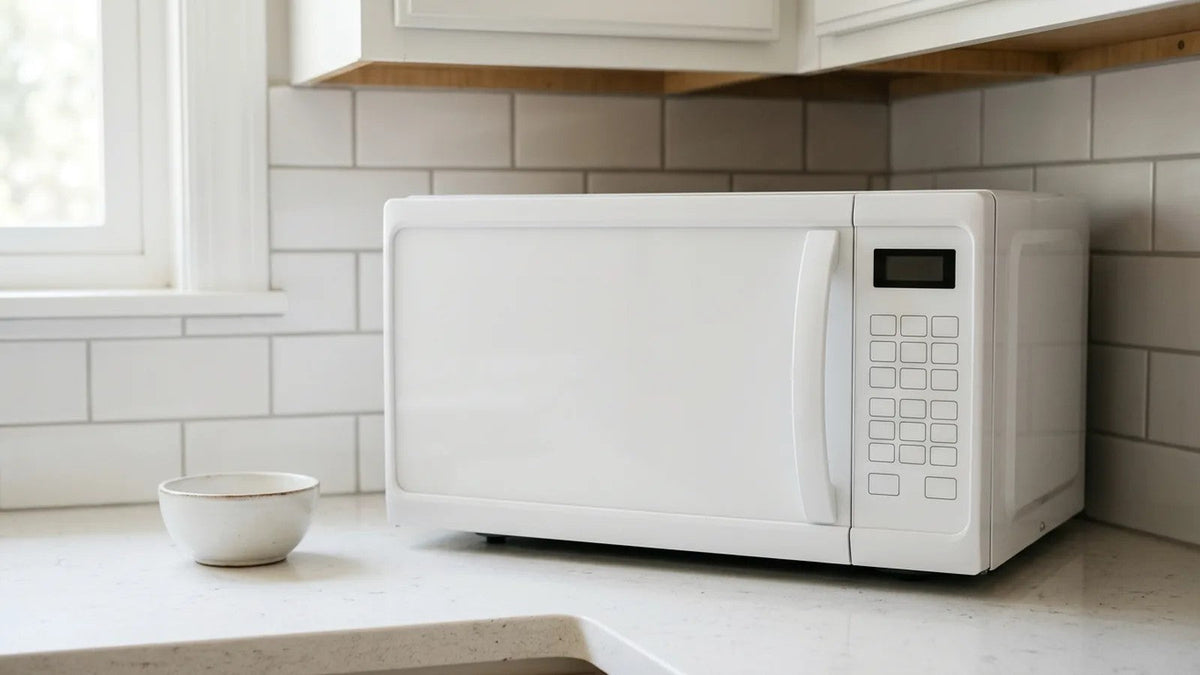
Picture this: you press Start on a bowl of leftovers and the microwave does nothing. Or you reach to stir halfway through and the door will not open. The fix depends on which lock is on, the keypad control lock or the child-resistant door, and the steps differ by brand and model. Whether you want to know how to child lock a microwave or why a door holds shut, start by working out which of the two you have.
Quick Answer: How to Unlock a Microwave by Brand
- A microwave can have two separate safety features. The control lock locks the keypad so the oven cannot be started. The child-resistant door takes two distinct actions to open.
- GE and Sharp say countertop microwaves made from April 2024 have a child-resistant door. An older microwave may have none.
- On older models, the keypad lock does not secure the door. Panasonic’s instructions for the NN-CD65NS say the Child Safety Lock "does not lock the door."
- The key or sequence changes from model to model. Confirm yours in the manual before pressing anything.
- Treat any lock as one layer on top of the basics you would find in a kitchen safety guide: reach, supervision and heating habits.
Start with the display sign, then find your brand. Whirlpool’s and LG’s help pages give only the steps to clear the lock.
| Brand | Lock name | Display sign | How to clear | Model range |
|---|---|---|---|---|
| GE | Control lock | "lock," often a small "L" | Hold Clear/Off or Pause/Off for about 3 seconds; other panels use Set Clock held 3 seconds or Mute pressed 3 seconds; some older models use the 5 and 7 pads together for 3 seconds | Over-the-range and countertop |
| Whirlpool | Control Lock | LOC, L or a padlock | Hold Cancel for 3 seconds or Start for 5 seconds, depending on the model | Countertop and over-the-range |
| Samsung | Child Lock | Check manual | Hold the Child Lock (3sec) key for 3 seconds | MS19M8000 |
| Samsung | Child Lock | CHILD LOCK ON or OFF | Press START for 3 seconds | ME21M706BA, ME21R706BA, ME21A706BQ (over-the-range) |
| Samsung | Child Lock | ON when locked | Press Kitchen Timer for 3 seconds | ME19R7041F (over-the-range) |
| Panasonic | Child Safety Lock | Check manual | Press Stop/Reset (or Stop on some models) three times | Many models made before March 2024, such as NN-CD65NS and NN-SC668S |
| LG | Childlock | "loc" | Hold STOP/CLEAR until "loc" disappears | NeoChef LMC0975, LMC1375, LMC1575, LMC2075 |
| Sharp | Door lock | Check manual | Press 7, 9, then 0 with the 0 held for 3 seconds to switch the door lock off or back on (leave it on in a home with a baby or toddler) | SMC0960KS, SMC1174KS |
Read the table from the display sign across. If you see LOC, an L, a padlock, "lock" or "loc," the keypad lock is on. If the keypad responds but the door holds shut during a cycle, or for a set time after one, it may be the child-resistant door, covered further down. A "Check manual" entry means the maker’s instructions change by model, so the manual for your exact model decides.
Two Locks, Two Jobs: Keypad Control Lock and Child-Resistant Door
Brands call the keypad lock Control Lock, Child Lock or Child Safety Lock. GE’s support pages describe it as a feature that "locks out the control panel pads so the microwave is not accidentally turned on when not in use." It stops the oven from starting.
The child-resistant door is a different feature. It makes the door itself take two distinct actions to open. GE keeps the two apart in its support pages, and so should you when you troubleshoot.
The stakes are burns. The AAP says most children who end up in burn units were burned by food or something involved in preparing and eating it, not by fire. It also warns that toddlers can start a microwave, open the door and remove the contents. The keypad lock addresses the starting step. The door addresses the opening step.
Height does not settle the question. The AAP says a microwave placed up high may still be within reach, because a child may climb on furniture or other objects to get to it. If you are baby-proofing every cabinet near the cooking area, add the microwave to the same walk-through and check what a child could climb. The CDC adds that children should always be supervised near the cooking area.
The display usually tells you which lock is on:
- Whirlpool: LOC, an L or a padlock icon means Control Lock is enabled.
- GE: the display shows "lock" and often a small "L."
- LG NeoChef models: the display shows "loc."
- Whirlpool countertop with the new 2-step door: a lit door icon means the child-resistant door is engaged.
- Newer GE countertop models: a door that will not open mid-cycle means the child-resistant door is engaged. GE calls that "normal for new models."
A few quick checks sort it out. If Start does nothing and a lock sign shows, the keypad lock is on. If the keypad responds and a cycle is running, but the door will not open when you pull, the child-resistant door is engaged. If neither sign appears and the door opens with a single press on an older microwave, it may be a model without a child-resistant door.
A mistake to avoid is treating the two as one lock. Someone clears the keypad lock, finds the door still shut, and assumes the lock did not clear. Someone else sets the keypad lock on an older model and assumes the door is secured too. Neither assumption holds up against the makers’ own instructions.


How to Turn Off Child Lock on Microwave: Control Lock Steps by Brand
Each maker below gives its own steps for its own models. Do not carry one brand’s sequence over to another, and do not assume a sequence from one model applies to its neighbor. Note exactly what your display shows before you press anything, because the sign tells you which row applies.
GE. GE says that on its over-the-range and countertop microwaves, the most common method on newer models is to press and hold Clear/Off or Pause/Off for about 3 seconds to lock the controls. The same hold unlocks them. Some older GE models use the 5 and 7 pads held together for 3 seconds. Other GE panels use Set Clock held for 3 seconds or Mute pressed for 3 seconds. GE says to unlock with the same procedure that locked the panel, so if you know how the lock was set, you know how to clear it. GE also notes the lock is kept after a power disconnection on some models but not all.
Whirlpool. Whirlpool’s help pages for its countertop and over-the-range microwaves say that when LOC, L or a padlock shows, Control Lock is on. They say to clear it by pressing and holding Cancel for 3 seconds or Start for 5 seconds, depending on the model. Those pages give only the clearing steps and refer owners to the Owner’s Manual for specific information on their model. If you are not sure whether your model uses Cancel or Start, the manual settles it.
Samsung. The key changes from model to model, so check yours. Samsung’s user manuals say to hold the Child Lock (3sec) key for 3 seconds on MS19M8000 models. On the ME21M706BA, ME21R706BA and ME21A706BQ over-the-range models, they say to press START for 3 seconds, and the display reads CHILD LOCK ON or OFF. On the ME19R7041F over-the-range model, they say to press Kitchen Timer for 3 seconds, and the display shows ON when the oven is locked. Those display messages let you confirm whether the lock took.
Panasonic. For many of its models made before March 2024, Panasonic’s instructions set the Child Safety Lock with three key presses, and the key depends on the model. On the NN-CD65NS, press Stop/Reset three times within 10 seconds while the display shows a colon or the time of day. On the NN-SC668S, press Start three times. To cancel, press Stop/Reset, or Stop on some models, three times. Panasonic says the lock stops the oven from operating electronically until it is cancelled. It also says the lock does not lock the door.
LG. On its NeoChef models, LG says to cancel the Childlock by pressing and holding STOP/CLEAR until "loc" disappears from the display. LG’s NeoChef help page lists the LMC0975, LMC1375, LMC1575 and LMC2075. The instruction is to hold the key until the sign is gone, not to tap it.
Say the keypad on your microwave will not respond and an "L" sits in the corner of the display. You now know it is the control lock, not a fault, and you can look up your model’s clearing step instead of pressing keys at random.
Three habits cut down on mistakes:
- Match the sign on your display to your brand’s row before pressing anything.
- Hold keys for the time your maker gives, since several of these steps are holds and not taps.
- Use the manual for your exact model when your model is not named above, because the key differs even within one brand.
Opening a Child-Resistant Door: Two Steps by Brand
The child-resistant door comes from UL’s safety standard for microwave cooking appliances. It is a requirement of that standard. UL Standards & Engagement published the requirement in 2018 and said it was anticipated to take effect in 2024.
It was proposed by medical researchers and doctors who had been tracking how many children were treated for severe microwave burns. The AAP describes what they saw: young children opening the microwave door, pulling out the heated food and spilling it on themselves.
The standard requires two distinct actions to open the door. UL gives sliding and pulling, or twisting and pushing, as examples that generally fit its intent. Touching two different touch pads also fits, as long as it is not the same pad twice. For you, that means a first action that tells the oven you want in, and a second that releases the latch.
Here is how each brand describes its two steps:
- GE countertop models: while the oven is running, press Start/Pause or Cancel/Off, then the door-release "push" button. On models with a Lock pad, press and hold Lock instead of the first button.
- Whirlpool countertop models with the 2-step door: press the Stop button and the Door Release button.
- Panasonic: on models made after March 2024, such as the NN-SB65NS AZH, press the Door Open key with the door closed, then the door-release button. Panasonic notes the Door Open key varies by model.
Timing varies too. GE says the two-step opening applies only while the oven is running. Once you open the door after cooking, it stays unlocked until the next cycle. Sharp says its door stays locked for 30 minutes after cooking or until you press the model’s Unlock key. Sharp’s statement, like GE’s, covers countertop models made from April 2024.
So a door that stays shut at the end of a Sharp cycle is following the timing Sharp describes. A door that holds shut mid-cycle on a newer GE countertop model is following what GE calls normal for new models.
UL’s standard also requires a way to switch the door lock off. That is either a three-digit code on touch controls or an operation that needs a tool, so people with mobility impairments can still use the oven. On the Sharp models its support page lists, such as the SMC0960KS and SMC1174KS, pressing 7, 9 and then 0 switches the lock off or back on. The 0 is held for 3 seconds.
Whirlpool says disabling it "should only be done when the owner is certain that children are absent." GE describes switching it off for households without young children or users with physical limitations. In a home with a baby or toddler, leave it on. If it is switched off for an adult who needs it, the door is back to opening in one step, which is what the AAP describes toddlers doing.
When a Lock Will Not Clear: Model Number, Manual and Support
If your brand and model are not above, or the lock stays on after you follow your steps, start with the model number. The AAP and the FDA both say to follow the manufacturer’s instruction manual, and that manual is written for your model, not for the brand in general.
Before you go further, make sure you are chasing the right lock. A keypad that ignores you with a lock sign showing is the control lock. A door that holds shut during a cycle, or for a set time after one, may be the child-resistant door working as the maker describes, and no clearing step applies.
Then use the maker’s own help:
- Whirlpool and Sharp organize their help by model number.
- Panasonic lists its steps model by model.
- GE says to consult the Owner’s Manual for the model you own.
If the manual’s steps do not work, contact the maker’s support with the model number ready. Tell them what the display shows and which steps you tried.
Do not count on unplugging to clear a lock, because makers describe different results:
- Panasonic’s instructions for its door-lock models say the locked door disengages when the unit is unplugged.
- Sharp says that on some of its models, a door locked when power is lost during cooking stays locked until power returns.
- GE says its control lock is kept after a power disconnection on some models but not all.
Because results vary by maker, the manual and support are the dependable route.
Older Microwaves Without a Child-Resistant Door
An older microwave may have no child-resistant door at all. A 2019 AAP Voices post noted that it would take time for existing microwaves to be replaced by newer, safer models. On those older units, the control lock covers only the keypad.
Picture this: you lock the keypad on an older microwave and step out to answer the front door. A toddler cannot start the oven. But the door can still open, and a bowl that just finished cooking is inside. Panasonic’s NN-CD65NS instructions say it plainly: the lock stops electronic operation and does not lock the door.
So for the door, rely on the AAP’s rules. Make sure young children cannot reach the microwave. Never leave a young child alone while food is cooking in it.
Use the keypad lock anyway. It takes the starting step away, and that is a real step. Just do not let it stand in for the rules above.
Rearranging the room matters here, in the same way keeping toddlers out of the fridge depends on what a child can physically get to. Look at the counter, the stools, the chairs and the boxes nearby. The AAP warns that a child may climb on furniture or other objects to reach a microwave placed up high.
Rules That Sit Around Any Lock
A lock adds a layer and does not replace the AAP’s microwave rules. Beyond reach and never leaving a young child alone while food cooks, the AAP says to stir food well or let it stand for two minutes before tasting. That lets the heat spread evenly. The CDC advises always supervising children near the cooking area.
The AAP also says a child too young to follow written directions is too young to use a microwave without supervision. A lock does not change that.
The FDA adds that you should not operate a microwave if the door does not close firmly or is bent, warped or otherwise damaged. A damaged door is a separate problem from a lock, and the lock does not make up for it. If you spot a door that sits crooked, stop using the microwave and follow the manufacturer’s instruction manual and support.
The oven beside the microwave has its own hazards, and oven door locks and stove guards address that part of the cooking area. The Oven & Appliance Safety Lock is an oven and appliance lock that attaches with the adhesive tape provided and needs no tools or drilling. Like any lock, it does not replace adult supervision.

What to Do Today
Find the model number and read your manual’s section on locks. Work out which lock your display shows, the keypad control lock or the child-resistant door, and use only the steps for that lock on your model. If you have a baby or toddler at home, leave the door lock on.
Then walk the room the way a toddler would. Ask what a child could climb to reach the microwave, and move anything that makes a step. On an older microwave, remember that the keypad lock covers only the keypad, so the door depends on reach and supervision.
If an oven shares the cooking area, locking the oven door is a separate job with separate hardware.
If a child is burned, call 911 or your pediatrician, and see the AAP’s guidance at HealthyChildren.org.
Before you next cook, practice your model’s keypad sequence once with nothing cooking, so you already know how to unlock the keypad when your hands are full.