How Tall Should a Baby Gate Be? Standard Heights, the ASTM Minimum, Widths and How to Measure
There is no single standard baby gate height. Here is the one federal minimum, how gate widths work and how to measure your opening before you buy.

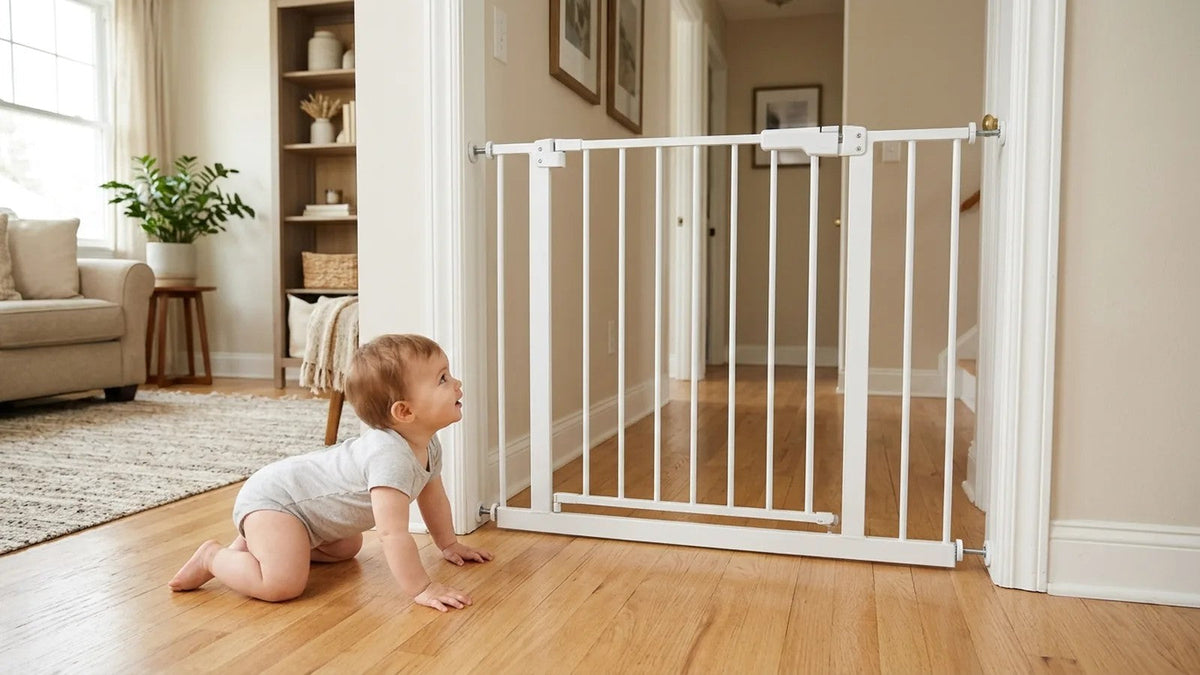
There is no single standard height to quote for a baby gate. The one federal number is a floor: CPSC’s 2020 final rule, which made ASTM F1004 mandatory, sets a 22-inch minimum, and makers build above it. So how tall should a baby gate be for your home? Start with each gate’s listed height and its stated opening sizes, then check the rest of the label.
How Tall Should a Baby Gate Be: What the 22-Inch Minimum Measures
When CPSC made ASTM F1004 mandatory in its 2020 final rule (16 CFR Part 1239), it described the "height of sides" requirement as the vertical distance from the floor to the lowest point of the uppermost surface. That distance shall not be less than 22 inches when measured from the floor.
It is a minimum for the lowest point of a gate’s top edge. It is not a recommended height. Makers choose their own heights above it.
CPSC gives the reason for the minimum: it is intended to prevent a child from being able to lean over and then tumble over the top of the gate. That is a limit placed on the product. It is not a promise about any one child.
The standard also tells you what kind of product we are talking about. ASTM F1004-19, as quoted in CPSC’s 2020 rule, defines an expansion gate as a barrier erected in an opening such as a doorway to prevent the passage of young children, but which older persons who are able to operate the locking mechanism can remove. Adults open it. Young children are meant to be kept on the other side.
If a large dog is part of the picture, tall baby gates are a separate question with their own guidance.
Who Gates Are Built For, and Where Height Stops Mattering
The height question has an age window. ASTM F1004 says the gates in its scope are intended for young children aged six months through 24 months. CPSC’s rule says gates and enclosures are not intended for children older than 23 months.
So the requirements, including the 22-inch minimum, are written for that age range. CPSC’s guidance to makers says retail packaging should state the recommended age of the user. If you are wondering what age gates can come down, that question has its own answer, and the age window above is where it starts.
Height is not the only question once a child climbs. CPSC reviewed emergency department injury data on gates for its rule and listed the circumstances of most of the falls:
- A child attempting to climb over or get through a barrier
- A child managing to unlatch a gate
- A gate that failed to stay upright and locked
- An adult carrying a child tripping over a gate
- A child pulling on a gate
Two of those five involve a child defeating the gate. CPSC’s guidance to makers says retail packaging should state that the product is not to be used with a child who is able to climb over, dislodge or open the gate. Once your child can do any of those three things, the gate is outside what that statement allows, whatever its height.
Standard Baby Gate Size: Opening Widths Vary by Maker
Standard baby gate size is a range, not a single number. CPSC notes that most gates sold in the United States for children expand because they vary in width. One gate is built to span a narrow doorway. Another is built for a wide hallway or an open room divider.
Baby gate dimensions differ from one maker to the next, and no single width applies to every product. So how wide are baby gates? The answer is whatever the maker states for that product. CPSC’s labeling requirements say the information packed with a gate must state the size openings the product is meant to be used on. That stated opening range is the figure to trust.
A gate’s own width and the opening it is meant for are different questions, and only the second one matters to you. If you are comparing styles for a staircase or a wide opening, a baby gate buying guide can help you sort mounts and latches. The opening range on the gate you pick still decides whether it fits.


How to Measure for a Baby Gate
Picture this: you have chosen a gate for the doorway between the kitchen and the living room, and the cart is open on your screen. The product page lists a height in bold. Before you click, you look at the doorway instead.
How to measure for a baby gate starts with the opening, then the maker’s range. Measure the width of the opening where the gate will mount. Then find the minimum and maximum opening widths the maker states, and check that your measurement falls inside them.
The range matters at both ends. The top-rail strength test CPSC described in its 2020 rule is run with the gate installed at both the maximum and minimum opening widths the manufacturer recommends. A gate stretched past its stated maximum, or squeezed below its minimum, is outside the conditions it was evaluated under.
Next, read what the instructions say about where to install the gate relative to the floor. Gates are required to include that information, and it varies by product.
Fit problems are on the federal record. In the incident reports CPSC reviewed for its 2020 final rule, the listed causes of installation problems include mismatched dimensions between the safety gate and the doorway or hallway opening, as well as unclear installation instructions. A gate that does not fit the opening is an installation problem before a child ever touches it.
Stairs: The Mount Comes Before the Measurement
At the top of the stairs, the measuring comes second. CPSC says that for the top of stairs, you should only use gates that screw to the wall. The AAP advises safety gates at both the top and bottom of the stairs when a child is learning to crawl and walk, mounted firmly to the home’s studs.
A gate meant for use at the top of the stairs must also state in its instructions the minimum distance to the first step.
Parents often ask whether stairs need a baby gate at all, and that question deserves its own full answer. The short version is that the AAP points to gates on stairs for crawlers and new walkers, and CPSC lists safety gates as a way to help prevent falls down stairs.
Two Checks Beyond Height: Older Styles and Pet Gates
Style matters as much as size, especially with a gate that is not new.
The AAP says to avoid accordion-style gates, which can trap an arm or a neck. CPSC says to replace older safety gates that have "V" shapes large enough to entrap a child’s head and neck. If a gate has been handed down, stored in a garage or picked up secondhand, look at its shape before you look at its height.
The second check is the purpose of the gate. CPSC says to use safety gates that meet current child safety standards. It also says that pet gates should never be used as a child safety gate. A gate sold to keep a dog out of the laundry room was built for a different job. A tall pet gate does not become a child gate by being tall. Borrowing one on height grounds is the wrong test.
Read the Label Before the Headline Numbers
Picture this: a product page leads with one large height figure. The opening sizes sit in smaller type further down, and the hardware limits are in a PDF. If you read only the headline, you miss the information that decides whether the gate fits and holds.
ASTM F1004 is the federal safety standard for expansion gates and expandable enclosures, made mandatory under 16 CFR Part 1239 (effective 2021). CPSC has since updated the rule to newer versions of the standard, most recently ASTM F1004-25, effective July 19, 2026. If you want the full label walkthrough, ASTM baby gate standards are covered in depth elsewhere.
Federal requirements call for the information with a gate to cover:
- The size openings the product is meant to be used on
- Any limits on the included mounting hardware
- Where to install the gate relative to the floor
- Instructions to stop using the gate if it becomes damaged, broken or disassembled
That list is more useful than any single number. A tall number is not the same as a safe gate. CPSC advises looking for gates that children cannot dislodge easily but that adults can open and close without difficulty. Latch design, mounting and fit count alongside height, and CPSC’s 22-inch minimum says nothing about whether a gate is the right width, mount or latch for your opening.
A Product Note: Baby Proof Me’s Mesh Retractable Baby Safety Gate
Baby Proof Me’s Mesh Retractable Baby Safety Gate is hardware-mounted. Its listed package contents include a main gate, an instruction manual, two latches, an upper and a lower bracket, installation screws, anchor screws, drywall screws, drywall anchor screws and two optional floor hooks.
The product page describes it as extra-wide, with a listed height of 34 inches. For the opening range, check the product page and compare it with your own measurement, as described above.
A few more listed features:
- The mesh rolls up with one hand when not in use.
- It has no bottom bar.
- The adjustable hardware slides up and down to fit around baseboards.
- The dual-rotation lock turns clockwise to lock and anti-clockwise to unlock, with one-hand operation.
Follow your own gate’s instructions for mounting and use. Baby Proof Me’s product page says the gate is not a substitute for adult supervision, and to stop using it immediately if it becomes faulty.