Baby Proof Your Christmas Tree: A Step-by-Step Safety Guide
Ornaments, lights, water, tinsel: a Christmas tree is a collection of hazards at toddler height.

The holiday season brings a particular kind of chaos to homes with small children, and I mean that in the best possible way. But I also mean it literally. The year my older daughter turned two, I watched her dismantle the bottom third of our Christmas tree in about four minutes while I was on the phone with my mother. Ornaments on the floor, tinsel in her mouth, one hand reaching toward the light strand. In my experience, a beloved tradition can become a genuine emergency very quickly.
The Christmas tree is a strange thing to bring into a home with babies and toddlers. It’s a large, climbable structure decorated with small breakable items, draped in electrical cords, and sitting in a reservoir of chemically treated water. And we put presents underneath it. We are essentially building a toddler obstacle course and calling it festive.
Why the Tree Is Riskier Than It Looks
The numbers are sobering. The CPSC’s Holiday Safety Information Center reports that emergency rooms treat thousands of injuries related to holiday decorating every year, with young children accounting for a disproportionate share of those visits. Cuts from broken ornaments, electrical burns, falls from climbing, and ingestion of small parts all appear in that data.
The NFPA adds another layer: Christmas trees are involved in roughly 160 home fires annually, with electrical distribution or lighting equipment cited as the leading cause. A child pulling on a light cord doesn’t just risk a shock. They can loosen a strand from a socket in a way that creates a fire hazard later, when everyone is asleep.
None of this means you can’t have a tree. It means you need a plan before you hang the first ornament.
Start With the Tree Itself
Before anything goes on the tree, think about the setup. A real tree needs to be fresh. The NFPA recommends keeping it well-watered and away from heat sources, since a dry tree can ignite in seconds. But keeping it well-watered creates its own problem with small children, which I’ll address shortly.
Anchor the tree. This is non-negotiable. A standard tree stand is not designed to resist a 25-pound toddler grabbing a low branch and pulling. Use a hook-and-eye anchor attached to the wall or window frame, with a clear fishing line or thin cable run from the trunk to the anchor point. It’s nearly invisible and it works. I’ve used this method for three years running, and it held when my younger daughter decided the tree was something she could lean into like a doorframe.
For artificial trees, check that the stand locks each section firmly. Wobbly sections are a collapse risk, and a falling tree, even a small one, can injure a child underneath it.
Place the tree in a corner if possible. Two walls are better than open floor space. It limits approach angles and gives you more options for gating.


The Ornament Problem
Here’s the rule: any ornament smaller than 1.75 inches in diameter is a choking hazard for children under three. That’s the CPSC’s small parts standard, and it applies directly to holiday decorations. The classic glass ball ornament, the kind your grandmother had, often falls right at or below that threshold. So does anything shaped like a small animal, a star, a candy cane, or a bell.
The solution isn’t to eliminate ornaments. It’s to zone the tree.
Keep the bottom 18 to 24 inches of the tree completely clear of small or breakable ornaments. Use only large, soft, or fabric decorations in that zone, the kind that can be mouthed, dropped, or thrown without consequence. Save the glass, the small, and the sentimental for the upper branches where small hands can’t reach.
I keep a separate box labeled "bottom of tree" with our child-safe ornaments, such as wooden shapes, knit figures, oversized felt stars. My older daughter actually loves decorating that section herself now. She has ownership over it. She can see the fragile ornaments but knows they’re "up high, for looking."
And skip the tinsel entirely. It’s a linear foreign body risk, the kind of thing that can cause serious internal injury if swallowed. No amount of sparkle is worth that.

- Unsecured trunk, tip-over risk
- Low ornaments, choking hazard
- Exposed light cords, shock and strangulation
- Open tree stand water, toxic ingestion risk
- Floor-level outlet, cover when not in use
Tree Water Is Not Innocent
This often surprises parents. The water in a live tree stand looks harmless. It is not.
Commercial tree preservatives, the packets that come with cut trees or are sold separately, often contain fertilizers, fungicides, and other chemicals. Even without additives, standing tree water accumulates bacteria, mold, and resin compounds from the trunk over time. The CPSC advises keeping tree water inaccessible to children and pets.
Cover the tree stand completely. A fitted tree skirt helps visually, but a determined toddler will lift it. Use a physical barrier: a small section of pool noodle cut to fit around the trunk, a custom-cut piece of cardboard, or a purpose-built tree stand cover that snaps or ties in place. Some parents use a playpen or freestanding gate around the entire base of the tree. This is one of the most effective strategies for families with crawlers or young walkers.
If your child does get into the tree water, call Poison Control at 1–800–222–1222. Don’t wait to see if symptoms develop.


Light Cords and Electrical Safety
Light strands are where I see parents underestimate the risk most consistently. A cord draped low on a tree is a tripping hazard and a strangulation risk for infants and young toddlers. It can also be an electrical hazard if the cord is frayed, overloaded, or repeatedly pulled from the socket.
Check every strand before it goes on the tree. Look for cracked insulation, exposed wire, broken sockets, or bulbs that flicker irregularly. The CPSC recommends replacing any strand that shows damage rather than taping or repairing it. Electrical tape is not a fix.
Use LED lights. They run cooler than incandescent bulbs, draw less power, and are less likely to cause burns if a child touches them. They’re also less likely to ignite nearby needles if a bulb fails.
Tuck cords up and into the tree rather than letting them drape. The cord from the tree to the outlet should run along the baseboard. It should not run across open floor, and should be secured with cord clips, not tucked under a rug, where heat can build. Use a single power strip with a built-in circuit breaker for all your holiday lights, and turn everything off when you leave the room or go to sleep. Every time. Without exception.
Consider outlet covers on any exposed sockets near the tree, and if you’re using an extension cord, make sure it’s rated for the load you’re putting on it.
Christmas Tree Safety Checklist
Gate the Whole Zone
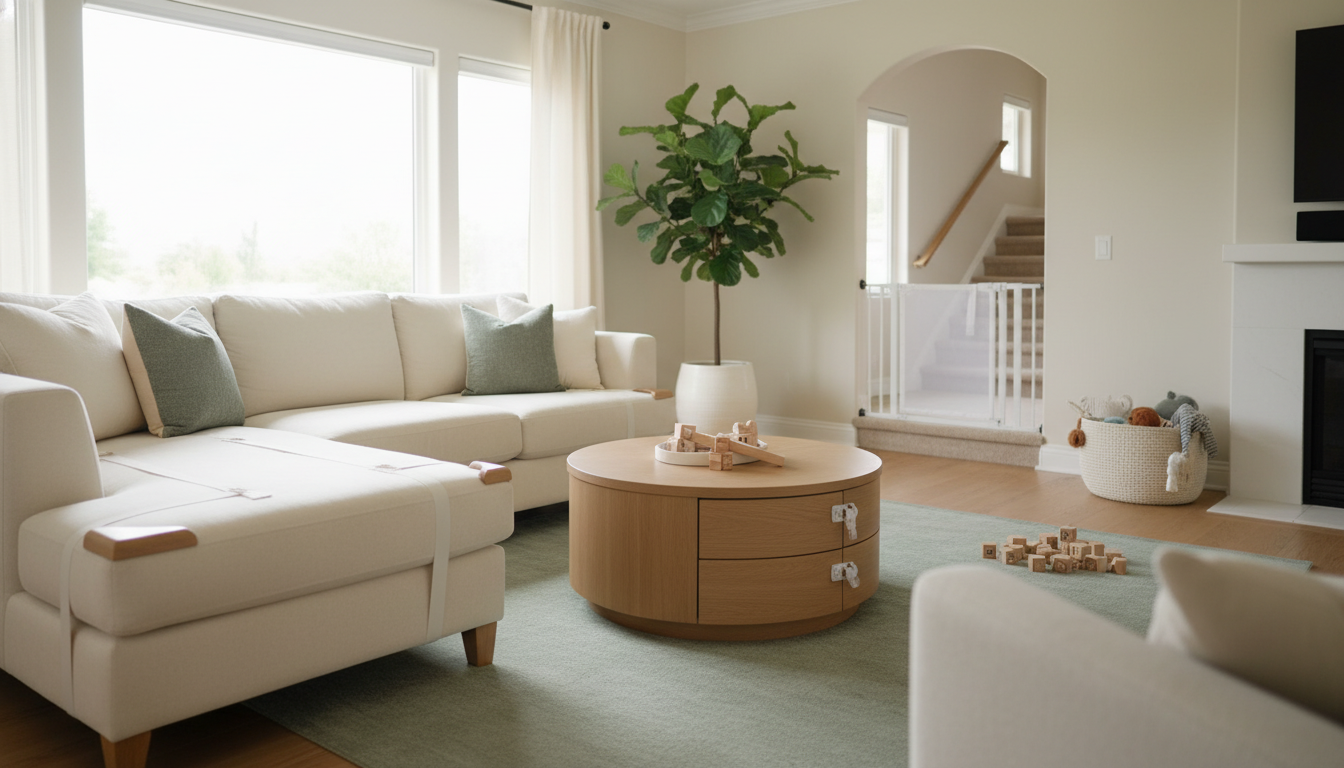
If your child is under 18 months, the most effective safety measure isn’t any single product, it’s a perimeter. A freestanding play yard or a pressure-mounted gate configured around the tree removes the variable of your own attention. You will get distracted. The doorbell will ring. Someone will need a snack. The gate works while you don’t.
I used a six-panel freestanding gate for two full holiday seasons. Yes, it looked a little like a livestock pen in my living room. It also meant I could walk to the kitchen without doing a threat assessment first.
As children get older and more reliably responsive to "no," you can relax the perimeter. But under two, the gate is the move.
The Gift Situation
Presents under the tree are their own category of hazard. Ribbon and curling ribbon are choking and strangulation risks. Small gift tags can be swallowed. Boxes wrapped in crinkly paper are irresistible to babies who are in the mouthing-everything phase.
Keep gifts off the floor until the day of. Store them in a closet or another room and bring them out Christmas morning. If you want the look of presents under the tree, use empty boxes wrapped in plain paper as decorative placeholders.
Enjoy It
I know this list is long. I know it can feel like you’re engineering a safety protocol instead of decorating for the holidays. But most of these steps take ten minutes total, and you do them once. After that, the tree is just the tree, beautiful, lit, and something your kids will remember for the rest of their lives.
The goal was never a sterile holiday. It’s a safe one. And those two things are not in conflict. Anchor the tree, zone the ornaments, cover the water, check the cords, and put up the gate. Then make some cocoa and let your kids stare at the lights.
That part is still magic. That part hasn’t changed at all.