How to Baby Proof Your Garage: Chemical Storage Tool Safety and Door Locks

Most parents childproof the kitchen and the bathroom without a second thought. The garage gets a mental asterisk: I’ll deal with that later. But "later" has a way of arriving the moment a curious two-year-old figures out the door handle.
The garage is, by almost any measure, the most hazardous room in a typical home. It concentrates automotive chemicals, power tools, flammable liquids, heavy equipment, and a large moving door with serious mechanical force into a single space that most families treat as semi-secured storage. That assumption is the hazard.
Start with a Full Audit Before You Buy a Single Lock
Before you order cabinet latches or door alarms, walk your garage with a notepad and get low. Literally crouch down to toddler height and look at what’s accessible. You will see things differently from 30 inches off the ground.
I did this exercise when my younger daughter was about 14 months old. From standing height, my garage looked reasonably organized. From her height, I could see an open shelf with a half-empty jug of windshield washer fluid sitting at arm’s reach, a power strip with three cords trailing across the floor, and a bag of fertilizer that had been left leaning against the bottom shelf rather than stored on it. None of that was visible to me when I walked in as an adult.
Your audit should produce four lists:
- Chemicals and toxins (any liquid, powder, or spray that could cause harm if ingested, inhaled, or touched)
- Sharp and cutting hazards (tools, nails, blades, broken equipment)
- Crush and pinch points (the garage door itself, shelving, heavy equipment, stored items that could tip)
- Access points (every door, gate, or opening between your home and the garage)
Work through each category systematically. This takes 20 minutes and it will shape every decision that follows.
Chemical Storage: The Highest-Stakes Category
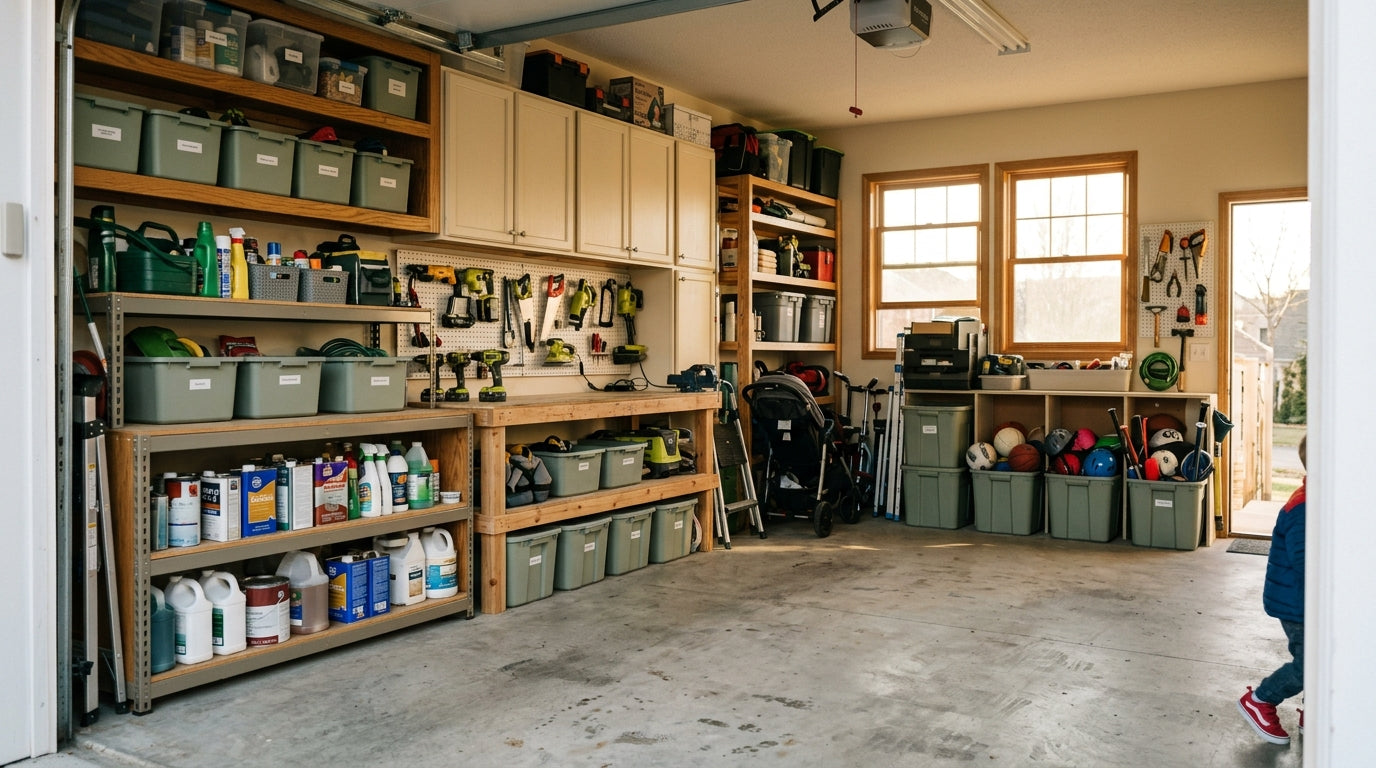
Pesticides, fertilizers, paint thinners, antifreeze, motor oil, brake fluid, carburetor cleaner. Most garages contain a dozen or more substances that are toxic to children, and many of them are stored in ways that invite accidents.
The two rules here are non-negotiable. First: everything stays in its original labeled container. Antifreeze poured into a sports drink bottle, or fertilizer stored in a repurposed food container, creates a scenario where a child cannot be warned by appearance alone. Original containers have warning labels, child-resistant caps, and emergency contact information. Second: high shelf or locked cabinet, not both required but both preferred.
High shelves work until children can climb, which happens earlier than most parents expect. Locked cabinets are more reliable but require consistent use. The combination of both is the safest approach for any substance that is acutely toxic.
Antifreeze deserves a specific callout. It has a sweet taste that makes it attractive to children and pets, and ethylene glycol poisoning can cause kidney failure. Keep it in its original sealed container, stored above 48 inches or in a locked metal cabinet. The same applies to any automotive fluid.
For pesticides and herbicides, check your local hazardous waste disposal schedule. Many families accumulate half-empty containers of products they no longer use. Disposing of them properly removes the hazard entirely, which is always better than storing it more carefully.
Flammable Liquids Require Their Own Rules
Gasoline, propane, and solvents like paint thinner and acetone are a different category from general chemicals because they add fire risk on top of toxicity. Storing them incorrectly creates two hazards at once.
Gasoline must be stored in approved containers, specifically those certified for flammable liquid storage. Metal safety cans with spring-loaded caps are the standard. Plastic milk jugs, glass jars, or any unapproved container are not acceptable, and this is a fire code issue in most jurisdictions, not just a safety suggestion.
Keep flammable liquids away from any ignition source. That means away from the water heater, the furnace, the electrical panel, and any appliance with a pilot light. A detached garage is safer than an attached one for this reason. If your garage is attached to your home, the risk of a flammable liquid fire spreading to living spaces is real.
Propane cylinders for grills should be stored upright, capped, and outdoors or in a detached structure. They should never be stored inside an attached garage. Even a small leak in an enclosed space can create a combustible atmosphere.
The CPSC recommends that flammable liquids be stored in approved metal cabinets away from ignition sources. If you have a dedicated flammable storage cabinet, use it. If you don’t, it’s worth the investment if you keep more than a small quantity of these materials.


The Garage Door Is a Mechanism
The large overhead door is the most mechanically complex and physically powerful element in your garage, and it is not designed with small fingers in mind.
The CPSC recommends testing your automatic garage door opener’s auto-reverse feature monthly. The method is straightforward: place a roll of paper towels flat on the ground in the door’s path and close the door. It should reverse on contact. If it doesn’t, the opener needs adjustment or replacement before it’s used again. This test takes 30 seconds and should be part of your regular home maintenance routine.
The door’s springs and cables are under extreme tension. These are not components to inspect casually or adjust yourself. If a spring or cable looks worn, frayed, or damaged, call a professional. A broken torsion spring can release enough force to cause serious injury.
The pinch hazard along the door’s sides and between panels is significant. NEISS data from 1999 to 2008 found that U.S. emergency departments treated a child for a door-related injury roughly every 4 minutes. Pinching, not impact, is the leading mechanism, accounting for 54.8% of pediatric door-related ED visits. Roughly 4 in 10 of those visits involved children age 4 or younger.
When a door injury is severe enough to require hospitalization, amputation is the single most common diagnosis. Fingertip amputations are the typical outcome, and doors cause nearly 60% of all pediatric finger amputations in children under 10, per NEISS data from 2010 to 2019.
Install pinch guards on the hinge side of the garage door panels. Keep the wall-mounted opener button high enough that a child cannot reach it, and store any remote controls out of reach. Teach children, as soon as they’re old enough to understand, that the garage door is not a toy and the area near it is not a play zone.
Tool Storage: Tiered by Risk
Not every tool is equally dangerous, and your storage approach should reflect that.
Tier one (highest risk): power tools, circular saws, reciprocating saws, angle grinders, and any tool with an exposed blade. These belong in a locked cabinet or a locked drawer. Cordless tools should be stored with batteries removed, or at minimum with the safety lock engaged. A cordless drill with a charged battery left on a workbench is accessible to a child who can reach the bench.
Tier two (moderate risk): sharp hand tools like chisels, utility knives, and hand saws. Wall-mounted tool racks work well here, provided they’re installed above shoulder height, which means above 60 inches for most adults. Hooks and magnetic strips keep tools visible and organized while keeping them out of reach.
Tier three (lower risk but still worth addressing): nails, screws, drill bits, staples, and small hardware. These belong in sealed containers, not open bins. A curious child who gets into a jar of roofing nails is going to the emergency room. Stackable hardware organizers with latching lids are inexpensive and effective.
Workbenches and freestanding shelving units must be anchored to wall studs. A child who grabs a shelf edge to climb or pull themselves up can bring the entire unit down. Use heavy-duty L-brackets and locate studs properly before anchoring. Heavy items like toolboxes and paint cans belong on lower shelves, not stacked at eye level where they can fall.
Batteries Deserve More Attention Than They Get
Button batteries are in remote controls, key fobs, hearing aids, small electronics, and dozens of other devices that accumulate in garages. They look harmless. They are not.
An ingested button battery can cause severe internal burns in as little as two hours, per Poison Control and AAP data. The mechanism is electrochemical tissue damage, and it can occur even when the battery appears dead. This is not a slow-developing risk. Two hours from ingestion to serious injury is a narrow window.
Rechargeable battery packs for power tools are a secondary concern. They’re not a swallowing hazard, but lithium-ion batteries that are damaged, punctured, or improperly stored can overheat. Store them away from flammable materials and inspect them for damage before charging.
Keep all batteries, including loose AA/AAA cells, in a drawer or cabinet with a reliable latch. Don’t leave them on the workbench after a project. Dispose of used batteries through a proper recycling program rather than leaving them in a drawer where they might be mistaken for charged ones.
The Door Between Your Home and Garage
This is the access point most parents underestimate. The interior door connecting your home to the garage is often a standard passage door with a basic knob, and many poisonings happen when a child slips through it unnoticed while a parent is distracted.
Install a childproof handle cover or a keyed lock on this door. A door alarm that chimes when the door opens is an inexpensive addition that gives you an audible alert any time the door is used. These are available for under $20 and install without tools.
A pressure-mounted baby gate at the garage entry is a reasonable secondary barrier for families with toddlers, though it should not be your only line of defense. Pressure-mounted gates should meet ASTM F1004, the safety standard for expansion gates.
The garage entry door should also be self-closing if possible. A door closer mechanism installed at the top of the door ensures it latches behind you every time, eliminating the gap that forms when you walk through with your hands full and the door drifts open behind you.
Cabinet Locks for Garage Storage
Any cabinet in your garage that contains chemicals, cleaning products, or tools needs a lock that a child cannot defeat.
The relevant standard is ASTM F3492–21, the voluntary consumer safety specification for child-safety cabinet locks and latches in the U.S. Locks that meet this standard must withstand an average breaking force of at least 45.3 lbs across a 30-sample test. That’s the benchmark for resistance to a determined toddler.
Product selection matters. In March 2012, the CPSC recalled 900,000 Safety 1st Push 'N Snap cabinet locks after 140 children defeated them, and three reached toxic cleaning products including dishwashing detergent, window cleaner, and oven cleaner. Children as young as 9 months were able to open these locks. The recall is a useful reminder that not all cabinet locks perform equally, and that adhesive-mounted products deserve scrutiny.
My older daughter defeated an adhesive strap lock at 26 months. The adhesive had held for about eight months before she found the angle to pry the anchor plate away from the cabinet face. After that, I switched to screw-mounted locks for any cabinet containing anything I didn’t want her to access. The installation takes longer, but the security is meaningfully better.
For garage cabinets specifically, look for locks that mount with screws rather than adhesive, and verify that the mounting surface is solid enough to hold. Particle board cabinets may require toggle bolts or reinforcement plates. A lock that’s correctly specified but poorly mounted offers little real protection.
Garage Safety Checklist
Cleaning Products and Degreasers
Many parents think of garage cleaning products as less dangerous than household ones. The opposite is often true. Degreasers, carburetor cleaners, concrete etching compounds, and industrial-strength cleaners contain concentrations of caustic or solvent-based chemicals that exceed what you’d find in a typical kitchen cabinet.
Inventory everything. If you have products you don’t use regularly, consider whether they belong in the garage at all. Consolidating to a locked metal cabinet is the cleanest solution. If that’s not feasible, high shelves with childproof latches are the minimum standard.
Never store cleaning products in the same unlocked cabinet as rags, brushes, or other items you access frequently. Routine access means the cabinet gets opened often, which increases the chance it gets left unlatched.
Supervision Rules and Household Communication
Physical barriers matter. So does consistent communication with everyone who cares for your children.
The garage should be treated as a supervised-access-only zone, meaning no child enters without a parent or caregiver present. This rule needs to be communicated explicitly to babysitters, grandparents, and older siblings. "The garage is off-limits unless an adult is with you" is a clear, enforceable boundary.
Older children can be taught the specific reasons: the door is heavy and can hurt fingers, some of the liquids are poisonous, and the tools are sharp. Understanding the why makes children more likely to respect the rule and more likely to tell you if a younger sibling tries to get in.
Do a seasonal walk-through, at minimum twice a year. Look for frayed extension cords, containers that have started to leak, rust on tools that might indicate structural weakness, and clutter that has accumulated into climbing opportunities. Hazards in the garage tend to develop gradually. A can of paint that was sealed in spring may be leaking by fall. A power strip that was fine in March may have a damaged cord by October. Regular inspection catches these before they become incidents.
Putting It Together
The garage doesn’t require a complete renovation to be safe. It requires a systematic approach: audit first, address chemicals and flammables before tools, secure the access doors, and install locks that meet the relevant standard.
The goal is not to make the garage inaccessible forever. Children grow up, and eventually they’ll be in there helping with projects. The goal right now is to ensure that unsupervised access, which will happen at some point regardless of your intentions, doesn’t result in a poisoning, a crush injury, or a trip to the emergency room. Layered barriers, good storage habits, and consistent household rules get you there.