Safe Nursery Lighting: Night Lights Lamps and Dimmer Solutions

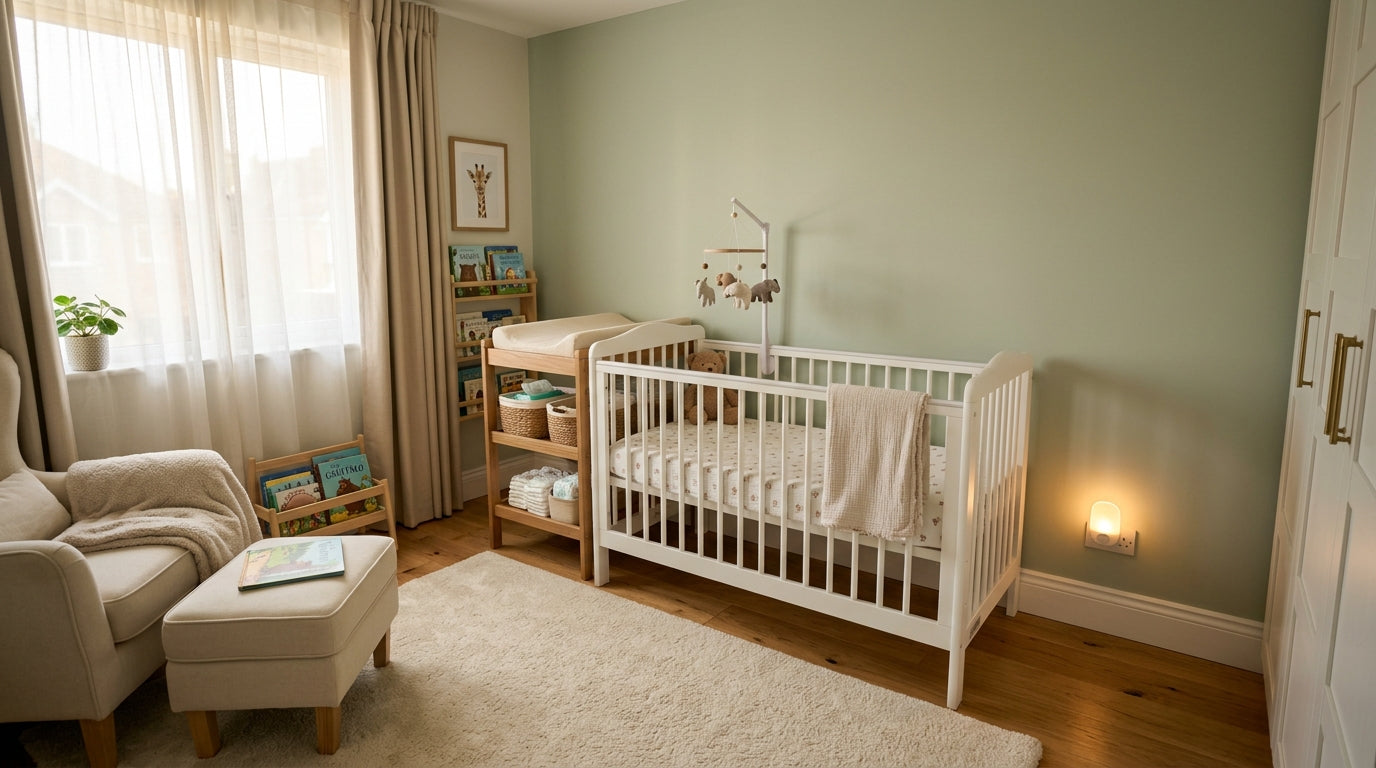
The nursery you’ve spent weeks setting up looks perfect at 2 p.m. At 2 a.m., it’s a different room entirely. You’re navigating in the dark, trying not to stub a toe on the glider, trying not to wake a baby who just fell back asleep, trying to see well enough to confirm the rise and fall of a tiny chest. Lighting in a nursery is a practical safety system, not a decorating decision. Getting it wrong costs you sleep. Getting it very wrong creates real hazards.
Why Light Color Matters More Than Brightness
Most parents focus on how bright a night light is. The color of that light matters just as much, and the AAP is clear on why. Warm light, at or below 2700K on the color temperature scale, is far less disruptive to melatonin production than cool or blue-toned light. Melatonin is the hormone that signals sleep onset, and infants’ developing circadian systems are sensitive to light cues in ways adult systems no longer are.
Cool white LEDs and especially blue-toned lights suppress melatonin production. A light that looks "soft" to you may still be emitting enough blue-spectrum wavelengths to interfere with your baby’s sleep cycle. When you’re shopping, check the color temperature on the packaging. 2700K or lower is the target. Anything marketed as "daylight" or "cool white" is typically 4000K to 6500K. Leave it on the shelf.
Colored lights are a separate issue. Red lights are sometimes marketed as sleep-safe, and there is some limited research suggesting red wavelengths are less melatonin-suppressing than blue. But the AAP has not endorsed specific colored lights for nursery use, and I’d steer clear of any color-tinted light unless your pediatrician specifically recommends it. Warm white is the safe, well-supported default. It also lets you see your baby’s skin color during nighttime checks, which matters clinically.
The Right Output Level for Safe Navigation
A night light’s job is to let you move safely through the room and check on your child without turning on overhead lights. That requires less light than most people assume. Roughly 4–10 lumens of output is enough for this purpose. For reference, a standard 60-watt incandescent bulb produces around 800 lumens. A night light at the low end of that range is dim by any measure, but adequate.
In my experience testing plug-in night lights for a full nursery setup, several popular options marketed as "nursery night lights" were outputting 25–40 lumens, which is enough to read by. That’s more than you need and more than you want if you’re trying to keep the room dark enough for sleep. Check the lumen output before you buy. Many manufacturers list it on the packaging or the product page; if it’s not listed, that’s worth noting.
The goal is visibility for you, not illumination for the room.


LED vs. Incandescent: Heat Is the Real Difference
LED fixtures have largely replaced incandescent bulbs in nursery applications, and the primary reason is heat. Incandescent bulbs convert most of their energy to heat rather than light. A bulb that’s been on for an hour can reach temperatures that cause burns on contact. In a nursery, where a curious toddler might touch a lamp at any point, that’s a meaningful risk.
LED night lights run cool to the touch even after extended use. In my experience, my older daughter at around 18 months made a habit of touching every plug-in light she could reach. With LEDs, that was a non-event. With an incandescent fixture in the same location, it would not have been.
LED fixtures also reduce fire risk in enclosed or semi-enclosed spaces. A night light tucked behind a dresser or near a curtain edge generates far less heat than an incandescent equivalent. That matters in a room where you may not be present for hours at a time.
Plug-In Night Lights: Placement and Outlet Safety
Plug-in night lights are convenient and inexpensive, but they introduce two hazards that need direct management. First, the outlet itself. Any outlet used for a night light should be a tamper-resistant receptacle (TRR). These have spring-loaded shutters that require simultaneous pressure from both prongs to open, which prevents a child from inserting a single object. If your nursery outlets are not tamper-resistant, a licensed electrician can replace them, or you can use plug-in outlet covers as a stopgap.
Second, placement. A night light at floor level is ideal for navigation purposes, but it also puts the fixture within reach of a crawling or cruising baby. Position plug-in lights behind furniture where possible, or in outlets that a toddler cannot easily access. If neither option works, battery-operated night lights eliminate the outlet hazard entirely. They cost a bit more over time due to battery replacement, but there are no cords, no exposed outlets, and no risk of a child unplugging the fixture.
Avoid night lights with dangling cords or decorative elements that could be pulled. Enclosed fixtures with no accessible moving parts are the right choice.
Avoiding Motion and Sound Activation
Motion-activated and sound-activated night lights are marketed as energy-efficient and convenient. In a nursery, they’re counterproductive. A light that switches on suddenly when you enter the room, or in response to your baby’s movement or sounds, can startle a sleeping infant and interrupt a sleep cycle that took 40 minutes to establish.
Consistent, low-level ambient light is better than intermittent bright light. If you want a light that’s off during daytime naps, use a manual switch or a simple timer rather than a motion or sound sensor. The goal is predictability. Infants orient to environmental cues, and a light that behaves inconsistently is a small but real disruption.
Lamp Cords, Placement, and Crib Clearance
Any lamp in the nursery requires cord management. The CPSC is explicit that cords near cribs are a strangulation hazard, and the guidance is a minimum 3-foot clearance between any cord and the crib. That applies to lamp cords, dimmer control cords, and monitor cables.
Secure cords to baseboards or walls using cord clips or cable raceways. Do not run cords under rugs, where they can fray undetected. Do not use extension cords as a permanent solution. If your lamp needs to be in a location that requires an extension cord to reach an outlet, move the lamp or have an outlet added.
Lamp placement matters beyond cord management. Floor lamps are generally inappropriate for nurseries with mobile children. A toddler can pull a floor lamp down onto themselves. Table lamps should be on surfaces that cannot be reached from the floor, with cords routed away from the crib and secured.
Dimmer Switches: What Works and What Doesn’t
A dimmable overhead fixture controlled by a wall switch is the most useful lighting tool in a nursery. It lets you bring the room up to full brightness for diaper changes and cleaning, then bring it back down to near-zero for settling a baby back to sleep, all without switching lights on and off and triggering the startle response that comes with sudden darkness or sudden brightness.
But dimmer installation is not a DIY project. Dimmer switches must be installed by a licensed electrician, and the dimmer must be matched to the specific bulb type you’re using. Not all LED bulbs are compatible with all dimmers. An incompatible combination causes flickering, buzzing, overheating, or premature bulb failure. When you purchase a dimmer, check the compatibility list that comes with it, or ask your electrician to specify the bulb at the time of installation.
A practical combination: a 4–6 lumen plug-in night light for ambient overnight visibility, plus a dimmable overhead on a wall switch for any task that requires real light. Two separate systems, each doing one job well.
Nursery Lighting Safety Checklist
Inspection and Maintenance
Night lights and nursery lamps are not set-and-forget fixtures. Inspect them monthly. Look for frayed cords, loose connections, discoloration around the plug or socket (which indicates heat buildup), and any physical damage to the housing. A night light that’s warm to the touch after a few hours of use, or that flickers without an obvious cause, should be replaced.
Check the CPSC recall database periodically. Nursery lighting products do get recalled. A fixture that was fine when you installed it may have a recall notice six months later. The CPSC website maintains a searchable recall list and allows you to sign up for email alerts by product category.
Replace any fixture that shows damage. The cost of a new night light is not a factor worth weighing against the risk of an electrical fault in a room where your child sleeps unsupervised.
Putting It Together
Good nursery lighting is a system. A warm-white, low-lumen night light handles overnight navigation. A dimmable overhead handles tasks. Tamper-resistant outlets and secured cords handle the hazards that come with mobile children. None of these pieces is complicated on its own. Together, they let you move safely through the room at 2 a.m., check on your child, and get back to sleep without turning the night into a production.
Start with the night light color temperature and lumen output. Get those right first. Then work through cord management and outlet safety. Add the dimmable overhead when you’re ready. The room doesn’t need to be perfect before the baby comes home, but it does need to be safe, and lighting is one of the easier systems to get right.