Best Travel Baby Proofing Kit: What to Pack for Safe Trips

Most parents baby-proof their home once and feel done. Then they book a vacation rental, walk in with a toddler, and realize the place looks like an obstacle course designed by someone who has never met a two-year-old.
I’ve been there. The first time I traveled with my older daughter, she was 18 months old and faster than I expected. Within ten minutes of arriving at a beach house, she had her hands on a floor lamp cord and was heading toward an uncovered outlet near the baseboard. I hadn’t packed a single outlet cover. I spent that first evening improvising with painter’s tape from my toiletry bag.
That trip changed how I pack. Here’s what I’ve learned since.
Why Travel Baby-Proofing Is a Different Problem
Home baby-proofing is a one-time project. You assess your space, install hardware, and adjust as your child grows. Travel is different because every new space resets that equation. Hotels, vacation rentals, and family homes all have their own outlet configurations, furniture layouts, cabinet contents, and door hardware. You can’t predict any of it in advance.
The hazards aren’t hypothetical. Outlets may sit at crawling height. Dressers in rental units are rarely anchored. Bathroom cabinets may hold cleaning products, medications, or personal care items that belong to the property owner. Blinds in older rentals often have long looped cords. And the furniture your child sleeps near is almost certainly different from what’s at home.
The goal of a travel kit is not to replicate your home setup. It’s to address the highest-probability hazards quickly, with gear that’s portable, doesn’t require drilling, and works across varied surfaces and door styles.
Portable Door Locks and Wedges
These are your first line of defense and the items I’d sacrifice everything else to keep in the bag.
Bathroom access is the most urgent risk in any hotel or rental. A child who gets into a bathroom unsupervised encounters hard surfaces, standing water, and often a cabinet full of products that aren’t yours. Door wedges and portable door handle locks block that access in under a minute and work on most standard interior doors without any hardware.
Connecting room doors in hotels are a specific hazard many parents overlook. These doors often have simple lever handles a toddler can operate. A travel door lock that fits over a lever handle takes care of this in seconds.
Look for locks that work on both round knobs and lever handles. Pack two. They weigh almost nothing.
Outlet Covers and Cord Management
Hotel and vacation rental electrical layouts are unpredictable. I’ve stayed in places with outlets at floor level, outlets directly behind the nightstand, and outlets positioned right at the height where a climbing toddler can reach them from a bed.
Sliding outlet covers are the most practical travel option. They’re flat, pack in a sandwich bag, and fit standard outlets. Bring at least eight. You’ll use more than you expect.
Cord management is the piece parents underestimate. Lamps, coffee makers, televisions, phone chargers, and alarm clocks all generate cords in a rental space, and those cords sit at exactly the height that interests a crawling or cruising baby. Cord shorteners and cable clips pack flat and take seconds to deploy. Secure cords up and behind furniture wherever possible. For cords you can’t move, a strip of cord bundlers keeps them tight against the wall and out of reach.


Window Covering Safety
This one matters more than most parents realize, and it’s specific to travel because older rental properties are far more likely to have looped blind cords than your home is.
The CPSC has identified window blind cords as a strangulation hazard for children under 5. Looped cords, whether inner cords or outer pull cords, can form a loop large enough to trap a child’s neck. In a rental, you have no control over what type of blinds are installed.
Before your child sleeps in any room, check every window covering. If there’s a looped cord, tie it up high and out of reach, or use a cord wind-up clip. If the cord can’t be secured above your child’s reach, move the crib or sleep surface away from that window entirely. This takes about two minutes and matters every single trip.
Arrival Safety Walk-Through
-
Secure the sleep room
Check all window blind cords, add a bed rail only for a child 2 or older in a regular bed, and use only the mattress pad that came with the travel crib. -
Lock the bathroom
Install door wedge or handle lock, add toilet lock, and place non-slip mat in the tub before your child enters. -
Cover outlets and manage cords
Insert sliding outlet covers throughout, then bundle and secure all lamp, TV, and charger cords behind furniture. -
Lock under-sink cabinets
Apply adhesive cabinet latches to bathroom and kitchen under-sink doors before unpacking any bags. -
Address furniture and gates
Attach anti-tip straps to dressers, pad coffee table corners, and install a pressure gate at the bottom of stairs or a kitchen entry, never at the top of stairs.
Furniture Anchors for Travel
Furniture tip-overs are a leading cause of unintentional injury in young children, and rental furniture is almost never anchored to the wall. Dressers, nightstands, and televisions on stands are all potential hazards.
Permanent wall anchoring isn’t an option in most rentals. Workarounds such as straps looped to a door hinge or weighted bases are not a substitute for anti-tip straps screwed into a wall stud. The safer moves are to ask the host to anchor large pieces before you arrive, empty the lower drawers, and keep your child out of rooms with unanchored dressers and TVs.
For televisions, the simplest approach is to move the TV to a position your child can’t access, or push it far back on its surface and block access to the furniture it sits on. If neither is possible, a travel anti-tip strap rated for the TV’s weight is worth the space it takes in your bag.
Bed Rails and Sleep Surface Safety
An unfamiliar bed is a fall risk and a gap risk. My younger daughter, at around 14 months, rolled off a bed at my in-laws’ house before I’d set up the portable rail. She was fine. I was not fine.
Portable bed rails fold flat and attach under the mattress without tools. They’re made for children about 2 to 5 years old who can get in and out of bed on their own, and the CPSC says never to use one for a child under 2. A baby or young toddler should sleep in a travel crib or play yard instead.
For infants still in a travel crib or pack-and-play, check the gap between the mattress and any side wall or headboard. Gaps that trap limbs are a real risk, and they vary by rental setup. The Safe Sleep for Babies Act (2022) bans padded crib bumpers and infant inclined sleep products with a sleep surface angle greater than 10 degrees. Instead, use only the mattress pad that came with the travel crib, make sure it fits the frame snugly with no gap, and never add a second mattress or extra padding; the CPSC has warned that add-on play yard mattresses can create gaps where babies can suffocate.
Cabinet and Drawer Locks
Under-sink cabinets in vacation rentals are a specific hazard because they often contain cleaning products that belong to the property. My younger daughter emptied an under-sink cabinet in the time it took me to answer the doorbell at our rental. Fortunately it was dish soap and a sponge. It could have been bleach.
Many of the products stored in rental cabinets are required by federal regulation to ship in child-resistant packaging. Under the federal Poison Prevention Packaging regulation (16 CFR Part 1700), specific household chemicals and medications must arrive in child-resistant packages. But that packaging only has to keep 80–85% of test-panel children (ages 42–51 months) out. It is not a substitute for a locked cabinet.
Travel cabinet locks need to work across varied door styles without drilling. Adhesive-based multi-purpose latches work on most smooth cabinet faces. For metal cabinets, magnetic locks that attach with industrial adhesive are a better option. Pack six to eight. Prioritize the bathroom under-sink cabinet, the kitchen cabinet nearest the floor, and any cabinet you can see from the entry that might hold cleaning supplies.
A 2012 CPSC recall pulled 900,000 Safety 1st Push 'N Snap cabinet locks after reports of children as young as 9 months opening them. When you’re evaluating travel locks, look for an ASTM F3492–21 claim on interior-mounted locks and test each lock yourself before your child has access to the cabinet.
Toilet Locks and Bathroom Safety
Drowning is the leading cause of unintentional injury death in children ages 1–4 (CDC), and a toilet presents a real drowning risk for an infant or young toddler. A child can drown in as little as one to two inches of water (AAP). Hotels and rentals have toilet configurations that vary widely, and many portable toilet locks fit standard hinges with no tools.
Pack one. They’re small, they’re cheap, and they address a hazard that’s easy to forget because it feels mundane.
Non-slip bath mats are also worth including. Rental tubs and shower floors are often slippery, and a child who isn’t used to the surface can fall. A foldable silicone mat takes up almost no space.
Portable Baby Gates
For open-concept rentals with stairwells or kitchen access, a portable gate is high on the priority list. Approximately 93,000 children under 5 are treated in U.S. emergency rooms each year for stair-related injuries (Nationwide Children’s Hospital analysis of CPSC NEISS data).
ASTM F1004 is the federal safety standard for expansion gates and expandable enclosures, made mandatory under 16 CFR Part 1239 (effective 2021). When you’re buying or packing a travel gate, look for ASTM F1004 compliance on the box.
Pressure-mounted gates work for most travel applications and don’t require drilling. They’re never appropriate for the top of a staircase, at home or away, but for blocking a kitchen entry, a hallway, or the bottom of stairs in a rental, they’re practical and fast to install. If a rental’s stair top has no gate, keep your child away from the top of the stairs unless you are right beside them. Measure your target opening before you travel and confirm the gate’s expansion range covers it.
Travel Baby-Proofing Kit Checklist
Corner Guards and Edge Bumpers
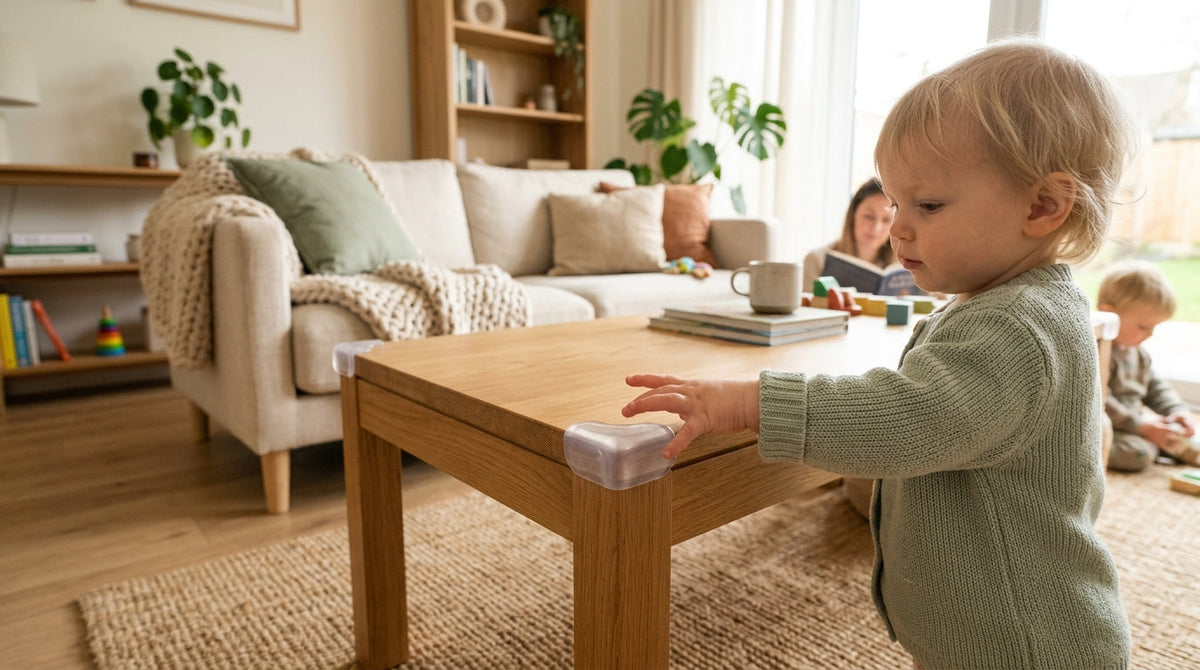
Unfamiliar spaces mean unfamiliar furniture layouts, and a toddler’s spatial awareness doesn’t update instantly when they walk into a new room. Coffee table corners, fireplace hearths, and exposed metal bed frame edges are all hazards in rental spaces that wouldn’t be present at home.
Foam corner guards with adhesive backing pack flat and apply in seconds. They leave minimal residue on most surfaces if removed within a few days. Pack a set of eight to twelve. Focus on the coffee table, any low glass surfaces, and the corners of the bed frame.
First Aid and Medical Documentation
Pack a basic travel first aid kit: adhesive bandages in multiple sizes, antiseptic wipes, gauze, medical tape, a digital thermometer, and any prescription medications your child takes. Include a written card with your child’s name, date of birth, weight, known allergies, current medications and doses, and your pediatrician’s phone number. If you’re traveling internationally, include the generic names of any medications.
This isn’t about expecting an emergency. It’s about reducing response time if something minor happens, and making sure that if something serious happens, anyone helping your child has the information they need immediately.
How to Pack and Deploy Effectively
The kit is only useful if you deploy it before your child accesses the space. That means doing a safety walk-through before bags are unpacked and before your child is set down to explore.
Prioritize in this order: sleeping space first, bathroom second, kitchen third, living areas last. Check window cords in the sleeping room before anything else. Lock the bathroom door or install the door lock before your child reaches the hallway. Secure under-sink cabinets before you unpack the kitchen bag.
If you can, request photos of the rental layout from the host before arrival. Knowing whether there’s an open staircase, a gas fireplace, or a glass coffee table lets you pack more precisely and deploy faster when you arrive.
A compact travel kit, well-organized in a single bag, should take about 20 minutes to deploy in a new space. That’s a reasonable investment before a week of not worrying about what your child is getting into while you’re in the other room.