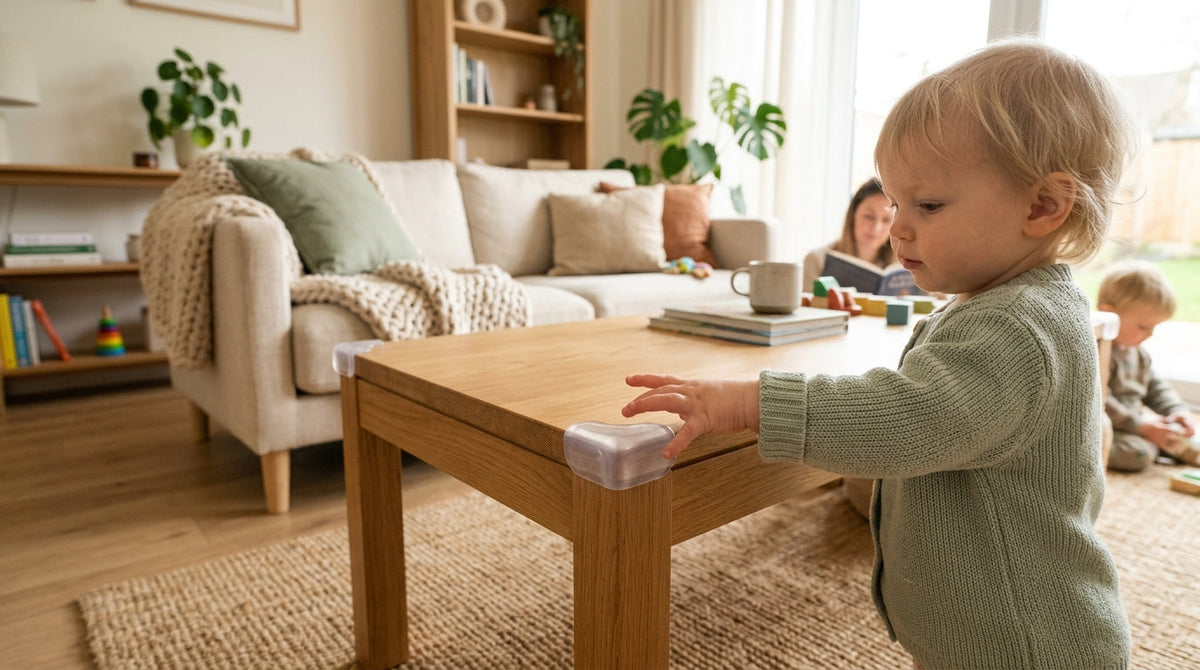
Foam vs Silicone vs Rubber Corner Protectors: Material Comparison

Every parent has that moment. You’re in the kitchen, you hear the thud, and your stomach drops before you even turn around. For toddlers learning to walk, the world is full of corners at exactly the wrong height.
Corner protectors are one of the simplest fixes in the babyproofing toolkit, but the material you choose matters more than most product listings let on. Foam, silicone, and rubber each behave differently under impact, age differently on your walls, and suit different rooms and budgets. Here’s what separates them.
How Each Material Handles Impact
The physics here are straightforward, even if the marketing rarely explains it clearly.
Foam compresses on contact. That compression is the protection. When a toddler’s forehead or cheekbone hits a foam-covered corner, the material gives way and spreads the force across a wider area over a slightly longer time. For children in the 12–36 month range who are still building balance and falling frequently, that softening effect is meaningful. The corner feels soft to the touch.
Silicone and rubber distribute force differently. They’re denser materials, so they don’t compress the way foam does. What they do instead is spread the impact load across the surface of the guard rather than absorbing it through deformation. The practical difference: a silicone corner will feel noticeably harder on initial contact than foam. It still reduces the sharp-edge risk, which is the primary hazard, but it doesn’t cushion the blow in the same way.
In my experience testing corner guards for our playroom, pressing firmly against each type showed clear differences: foam compressed, silicone pushed back, and rubber fell between the two. For a walking toddler, that difference is real.
Durability and Compression Over Time
Foam’s biggest weakness is that the same property that makes it protective also limits its lifespan. It compresses under repeated impact and, in high-traffic areas, it compresses under sustained pressure too. A foam corner on the edge of a coffee table in an active playroom will start to show permanent deformation within months. Most foam corner guards need replacement every 12–18 months in high-use spaces, sometimes sooner.
Silicone holds its shape. In my experience, silicone corner guards on the sharp edge of our entryway console for over two years look and feel essentially the same as when installed. The material resists compression and wear better than foam. The tradeoff is cost: silicone guards typically run 2–3 times the price of comparable foam sets.
Rubber sits in the middle. It’s more durable than foam under repeated impact and maintains its shape better over time. But rubber has a specific vulnerability that foam and silicone don’t share: UV degradation. In rooms with direct sunlight, rubber corner guards can yellow and become brittle within a year or two. If you’re considering rubber, keep it away from south-facing windows.
Adhesive Performance by Room
This is where the material choice gets consequential, and where I’ve seen the most failures in real homes.
Foam corners use pressure-sensitive adhesive that works well on smooth, clean, dry surfaces. In a dry living room or bedroom, a well-applied foam guard will stay put for months. In a bathroom or under-sink cabinet area, humidity causes the adhesive to soften and the foam itself to absorb moisture. In my experience, foam guards in humid cabinet areas showed peeling at corners within four months.
Silicone adhesive bonds differently. The material itself is hydrophobic, meaning it repels water rather than absorbing it. In humid kitchens and bathrooms, silicone corner guards maintain their bond significantly better than foam. The catch is surface preparation. Silicone requires a clean, fully degreased surface for the adhesive to bond properly. Skip that step and you’ll get early failure regardless of the material’s inherent durability.
Rubber performs adequately in moderate humidity but doesn’t match silicone’s resistance in consistently wet environments.


Hygiene and Cleaning
Foam traps moisture. It also traps dust, crumbs, and anything else that drifts against it. In a dry playroom, that’s a minor annoyance. In a bathroom or kitchen, it’s a real hygiene concern. Foam corners in damp rooms can develop mold or mildew on the adhesive side or within the material itself, and you often won’t see it until you remove the guard.
Silicone and rubber are both non-porous. You can wipe them down with a damp cloth, a mild cleaner, or a disinfectant wipe without degrading the material. For any room where cleaning frequency matters, that’s a meaningful advantage.
Foam vs. Silicone vs. Rubber at a Glance
| Feature | Foam | Silicone | Rubber |
|---|---|---|---|
| Impact cushioning | Best (compresses) | Moderate (distributes) | Moderate (distributes) |
| Durability | 12–18 months | 2+ years | 1–2 years |
| Humidity resistance | Poor | Excellent | Moderate |
| UV resistance | Good | Good | Poor |
| Wall damage on removal | Low risk | High risk | Moderate risk |
| Relative cost | Lowest | 2–3x foam | Mid-range |
| Ease of installation | Easiest | Moderate | Moderate |
| Hygiene (wipe-clean) | No | Yes | Yes |
Installation Difficulty and Wall Damage on Removal
Foam is the easiest material to work with. It cuts cleanly with scissors, conforms reasonably well to irregular surfaces, and applies with hand pressure. If you have a corner that isn’t a perfect 90-degree angle, foam will accommodate it better than rigid alternatives.
Silicone and rubber are stiffer. On textured walls or unusual angles, getting full adhesive contact can be difficult without some heat to soften the material first. A heat gun helps, but it adds a step that many parents skip, which leads to partial bonding and early failure.
Removal matters too, especially for renters. Foam peels cleanly from most painted surfaces with minimal risk of damage. Rubber is moderate risk. Silicone is the highest risk of the three. If the adhesive bond is strong and you remove it quickly or at a cold temperature, you can pull paint or drywall finish with it. If you’re renting, silicone corner guards require more care on removal, including scoring the adhesive with a plastic tool and working slowly.
Safety Standards and Material Safety
There is no federal safety standard written for corner guards. Federal phthalate limits apply to toys and child care articles, and most childproofing devices fall outside them, so look for a maker that states the material is phthalate-free and BPA-free and can show third-party lab results. The JPMA certification program also covers juvenile products and provides an additional verification layer for safety-focused buyers.
There are no standardized impact ratings for corner protectors the way there are for helmets or car seats. Safety standards in this category focus on material non-toxicity and secure fastening rather than quantified impact absorption. That means the "protection" claims on packaging are largely marketing. What you can verify is material safety and adhesive security.
ASTM International publishes consumer safety standards that cover material composition and testing methods for juvenile products. When a corner guard references ASTM compliance, it’s typically referring to material safety testing, not impact performance.
Aesthetics and Visibility
Foam is available in a wide range of matte colors, including shades designed to match common wall colors. Done well, a foam corner guard can be nearly invisible from across the room. Done poorly, it looks like a beige blob on your furniture.
Silicone offers glossy and translucent finishes. Clear silicone guards on light-colored furniture can be quite subtle, though the glossy surface catches light in ways that matte foam doesn’t. On dark furniture, clear silicone can look like a smudge.
Rubber tends toward an industrial look. The material finishes are typically matte black, grey, or brown, and the guards are often thicker and more visually prominent. If aesthetics matter in your space, rubber is usually the most visible option.
Long-Term Cost and Where Each Material Makes Sense
The math on foam versus silicone shifts depending on where you’re installing them.
In a high-traffic playroom or hallway, foam guards that need replacement every 12–18 months will cost more over three years than a single set of silicone guards installed once. Silicone’s higher upfront cost, typically 2–3 times foam, is offset by longevity in spaces that see daily contact.
In a guest bedroom that children visit occasionally, foam is the right call. The adhesive will hold, the compression won’t be an issue, and you’re not paying a premium for durability you don’t need.
Rubber occupies a reasonable middle position for spaces with moderate traffic and no direct sunlight. It’s more durable than foam without silicone’s price point, as long as you keep it out of UV exposure.
Homes with Pets and Multiple Children
I want to flag this specifically because it changes the calculus. A dog that leans against corners, or an older child who climbs on furniture, creates a different wear pattern than a toddler walking past. Repeated lateral pressure, jumping, and climbing compress foam unevenly. You’ll often see foam guards develop a flattened side while the other side remains intact, which means you’re replacing them more frequently and the protection is inconsistent in the meantime.
Silicone and rubber maintain consistent shape under these conditions. If you have a dog or older kids in the house alongside your toddler, that consistency matters. When I installed guards on our bookcase after my older daughter started using the shelves as a climbing structure, I switched to silicone specifically because I knew foam wouldn’t survive the lateral pressure.
Making the Call
For most families, the answer is silicone in high-traffic and humid rooms, foam in low-traffic and dry spaces, and rubber as a reasonable middle option where UV exposure isn’t a factor. Buy foam for guest rooms and secondary spaces. Invest in silicone for the coffee table in the living room, the kitchen island corner, and anywhere in the bathroom. Avoid rubber near windows.
Whichever type you buy, check for third-party testing that the material is phthalate-free and BPA-free, and check the guards often. A guard a child can peel off or bite pieces from becomes a choking hazard.