Living Room Furniture Anchoring: TV Stands Bookshelves and Dressers

The furniture in your living room looks stable. It probably isn’t.
A bookshelf bolted to nothing. A TV stand with a 65-inch screen perched on top. A dresser your toddler has already figured out how to use as a ladder. These are not hypothetical hazards. CPSC reports one child death every two weeks from furniture, TV, or appliance tip-overs, and nearly 80% of those fatalities involve children age 5 and younger. An average of 17,800 people visit emergency rooms each year for furniture and TV tip-overs (CPSC 2023 report). The math is not complicated. The fix, mostly, is.
Why Heavy Furniture Still Tips
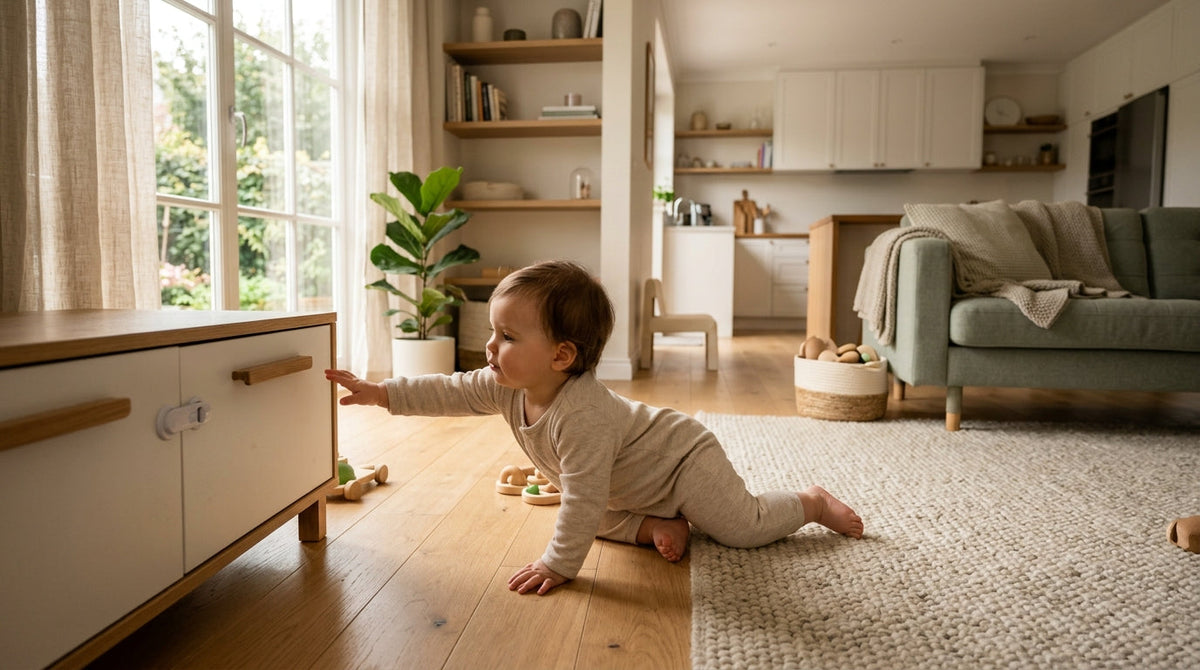
The most common misconception I hear from parents is that a heavy piece of furniture is a safe one. My older daughter was 28 months old when she pulled open the bottom two drawers of a tall dresser and used them as steps. The dresser weighed over 80 pounds. She had it rocking within seconds.
Weight does not prevent tip-overs. Physics does, when it’s working in your favor. A piece of furniture is stable when its center of gravity sits over its base. The moment a child opens a drawer, hangs on a shelf edge, or pulls on a door, that center of gravity shifts forward. The heavier the piece, the more force it carries when it falls. A 100-pound dresser landing on a three-year-old is not safer than a 40-pound one.
Wall anchors work by transferring that tipping force into the wall structure itself, specifically into the wood studs behind the drywall. The anchor doesn’t hold the furniture up. It prevents the top of the furniture from moving away from the wall. That distinction matters when you’re choosing hardware.
The Three Anchor Types and What They’re Good For
L-brackets are steel brackets bolted through the back panel of the furniture and into a wall stud. They’re the most rigid option and work well on solid-wood or plywood-backed pieces. The weakness: many modern flat-pack dressers and bookshelves have thin, stapled-cardboard backs that won’t hold a bolt under load. If you can push your thumbnail into the back panel, an L-bracket alone won’t save you. You’ll need to reinforce the attachment point or use a different system.
Strap and cable systems loop around the furniture body or through a dedicated anchor point and connect to a bracket screwed into a stud. They allow a small amount of movement, which makes them easier to install and more forgiving of furniture that shifts slightly over time. Most commercial anti-tip straps fall into this category. They’re the right choice for furniture with weak backs, for pieces you move occasionally, and for households with kids who are active climbers.
Adhesive anchors are designed for renters who can’t drill. They use industrial-strength adhesive pads to attach a strap or bracket to the wall surface. They work on smooth painted drywall, but they fail on textured walls, on walls with multiple paint layers, and on any surface that has moisture exposure. Check the load rating carefully. Most adhesive systems are rated for lighter furniture, and that rating assumes a clean, smooth, dry surface. If your bookshelf weighs 60 pounds loaded with books, verify the anchor’s rated capacity before trusting it.
Whatever system you choose, the anchor point in the wall must hit a stud. Drywall alone cannot support a tipping load. A screw in drywall will pull straight through when a child’s weight shifts a piece forward. Studs are typically spaced 16 inches apart. Use a stud finder, or knock along the wall and listen for the change in tone. Mark both edges of the stud and drive your screw or bolt into the center.


TV Stands: The Specific Problem of Top-Heavy Weight
TVs are involved in 47% of tip-over fatalities (CPSC 2023 report). That number is partly about volume, but it’s also about geometry.
A modern flat-screen television is wide, relatively light, and mounted high on a stand. That puts significant weight at the top of the furniture, which raises the center of gravity and creates a mechanical advantage for anyone pulling or climbing. A child doesn’t need to exert much force to start a TV stand moving when the mass is already distributed toward the top.
The stand itself is often the weakest link. Many TV consoles are designed for aesthetics, not structural loading. Open shelving, thin side panels, and minimal back framing all reduce the resistance to tipping. If your TV stand has an open back or a thin MDF panel, anchor it to the wall with a strap system and attach the strap as high on the stand as the hardware allows. Higher attachment = better leverage against the tip direction.
Also anchor the TV to the stand if your stand has a mounting point for it. Some stands include a cable slot or bracket for this purpose. If yours doesn’t, a simple anti-tip strap rated for your TV’s weight, looped through the VESA mounting holes on the back of the set, adds a second layer of protection.
Keep the area around the TV stand clear. Toy bins, step stools, and even thick books stacked on the floor can become a climbing aid.
-
Locate the stud
Use a stud finder and confirm with a small pilot hole. Studs are typically 16 inches apart. -
Choose the right anchor type
L-bracket for solid-wood backs, strap system for thin or flat-pack backs, adhesive only for smooth rental walls. -
Attach to a structural point
Fasten to a frame rail, solid side panel, or reinforced back, never a decorative or cardboard panel. -
Position the anchor high
Mount the wall bracket as high as the furniture allows for maximum leverage against the tip direction. -
Add a second anchor for tall pieces
Bookshelves over 48 inches should have one anchor near the top and one at mid-height. -
Inspect every 6 to 12 months
Grab the top of each piece and push forward firmly. Tighten or replace any hardware that allows movement.
Bookshelves: Two Failure Modes, Not One
A bookshelf can hurt a child in two distinct ways. The whole unit can tip. Or individual items on the shelves can fall.
Anchoring addresses the first problem. For the second, load management matters. Books are heavy. A full shelf of hardcovers can weigh 30–40 pounds. Store the heaviest items on the lowest shelves. This lowers the center of gravity and reduces the risk of the shelf itself tipping, and it means that if something does fall, it falls from a lower height.
Bookshelves are also natural climbing structures. The shelves are evenly spaced, they protrude just enough to grip, and they’re full of interesting things. Children climb them the same way they climb ladders. An unanchored bookshelf used as a ladder will tip at the moment the child’s weight moves past the tipping point, which is usually when they’re near the top.
Anchor tall bookshelves at two points if the height allows. One anchor near the top, one at mid-height. Two anchor points distribute the load and prevent the shelf from pivoting around a single attachment. For freestanding shelves taller than 48 inches, this is worth the extra hardware.
Dressers: The Bedroom Statistic That Should Travel With You
Half of all child tip-over deaths happen in the bedroom (CPSC), the room where dressers and chests are the dominant climbable furniture. Chests, bureaus, and dressers caused 36% of all U.S. tip-over deaths in CPSC’s latest reporting, and 81% of those deaths were children (CPSC 2023 Annual Tip-Over Report).
The drawer-ladder problem is the core of it. Children open the bottom drawer, step in, open the next one, step up. It works until it doesn’t. The dresser’s own weight becomes the hazard.
Anchor your dressers even if they’re in a room your child doesn’t regularly sleep in. Children visit other bedrooms. They play in rooms you haven’t fully childproofed. They have sleepovers at grandparents’ homes with furniture that has never been anchored. You can only control your own space, but in your own space, anchor everything.
For dressers specifically: keep the drawers closed when not in use. Some families add drawer stops or remove the bottom drawer entirely to eliminate the first step of the ladder. Neither of these replaces anchoring, but they add friction to the climbing sequence.
Installation: What Goes Wrong
The most common mistakes made during anchor installation are these.
Missing the stud. You think you’ve found it, you drive the screw, and it goes in too easily because you’ve hit the gap between studs. Use a quality stud finder and verify with a small pilot hole before committing to the anchor location.
Anchoring to the wrong part of the furniture. The anchor needs to attach to a structural element, a frame rail, a solid side panel, a reinforced back. Attaching to a decorative panel or a thin backing board gives you the appearance of security without the load capacity.
Skipping re-inspection. Wall anchors loosen. Furniture shifts. Kids bang into things. Check your anchors every 6–12 months. Grab the top of each piece and apply firm forward pressure. If there’s movement, tighten the hardware or replace it.
Using drywall anchors as a primary attachment point. Drywall anchors are for hanging pictures. They are not rated for the lateral and dynamic loads of a tipping piece of furniture. If you cannot hit a stud at the location you need, reposition the furniture so the anchor point aligns with a stud, or use a wall-mounted backing board that spans two studs.
Room-by-Room Anchoring Checklist
When Anchoring Isn’t Possible
Some rental agreements prohibit wall penetrations. Some wall types, tile, concrete, or plaster over metal lath, require specialized hardware that most adhesive systems can’t replace. Some furniture simply has no structural point to attach to.
In those cases, the honest answer is that the piece should not be in a space a child can access unsupervised. Move it to a room behind a closed door. Remove it from the home. Replace it with a lower, wider piece that is harder to tip. An unanchored 72-inch bookshelf in a living room with a toddler is not a solved problem just because you’ve run out of easy options.
If you’re in a rental and want to try adhesive anchors, test the adhesion on a small patch of your wall surface first. Wait 24 hours and apply firm pressure before trusting it with furniture. Verify the anchor’s rated load against the actual weight of your piece, loaded with whatever you normally keep on it.
Beyond the Anchor
Anchoring is the most important step. It is not the only one.
Talk to your children about furniture. Children who understand the rule are less likely to test it, though they will still test it.
Keep the area around tall furniture clear of anything a child could use to gain height. Chairs pulled up to a bookshelf, toy bins stacked near a dresser, a laundry basket next to a TV stand. These are all climbing aids. Move them.
Store heavier objects low. This applies to bookshelves, to TV stand cabinets, to the top of dressers. A heavy object falling from four feet hits with enough force to cause a serious head injury even without the furniture following it down.
The CPSC’s Anchor It! campaign has free anchor kits available through their website for families who need them. If cost is a barrier, that’s a real resource.
A properly anchored piece of furniture, with hardware into studs, attached to a structural part of the unit, and checked annually, will hold. That’s the standard to work toward for every tall piece in your home.